服務熱線:
400-693-3363
榮仕杰 · 智為人先焊接機器人工作站一體化集成/設(shè)計/制造商


熱門關(guān)鍵詞: 機器人點焊系統(tǒng)組成 點焊機多少錢 焊接工作站基本組成 螺母點焊機價格
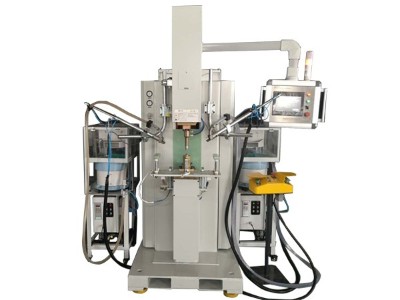
(內(nèi)容來自百度百科)點焊機按照用途分,有萬能式(通用式)、專用式;按照同時焊接的焊點數(shù)目分,有單點式、雙點式、多點式;按照導電方式分,有單側(cè)的、雙側(cè)的;按照加壓機構(gòu)的傳動方式分,有腳踏式、電動機-凸輪式、氣壓式、液壓式、復合式(氣液壓合式);按照運轉(zhuǎn)的特性分,有非自動化、自動化;按照安裝的方法分,有固定式,移動式或輕便式(懸掛式);按照焊機的活動電極(普通是上電極)的移動方向分,有垂直行程(電極作直線運動)、圓弧行程;按照電能的供給方式分,有工頻焊機(采用50赫茲交流電源)、脈沖焊機(直流脈沖焊機、儲能焊機等)、變頻焊機(如低頻焊機)。
2、點、縫焊的搭接接頭不僅增加了構(gòu)件的重量,且因在兩板間熔核周圍形成夾角,致使接頭的抗拉強度和疲勞強度均較低。
The spot welding machine is divided into universal type (general type) and special type according to the purpose; according to the number of welding points welded at the same time, there are single-point type, double-point type, multi-point type; according
to the conductive mode, there are single-side, Double-sided; according to the transmission method of the pressurizing mechanism, there are foot type, motor-cam type, pneumatic type, hydraulic type, compound type (pneumatic hydraulic combined type);
according to the characteristics of operation, there are non-automatic and automated; according to The installation method is divided into fixed, mobile or portable (hanging type); according to the moving direction of the movable electrode (usually
the upper electrode) of the welding machine, there are vertical stroke (the electrode moves linearly) and circular stroke; According to the power supply method, there are industrial frequency welding machine (using 50 Hz AC power supply), pulse welding
machine (DC pulse welding machine, energy storage welding machine, etc.), frequency conversion welding machine (such as low frequency welding machine).
When the workpiece and electrode are fixed, the resistance of the workpiece depends on
its resistivity. Therefore, the resistivity is an important property of the material to be welded. The metal with high resistivity has poor conductivity (such as stainless steel) and the metal with low resistivity has good conductivity (Such as aluminum
alloy). Therefore, when spot welding stainless steel, it is easy to generate heat and difficult to dissipate heat. When spot welding aluminum alloy, it is difficult to generate heat and easy to dissipate heat. When spot welding, the former can use
a smaller current (thousands of amperes), while the latter must use a large current (several Million amps). The resistivity depends not only on the type of metal, but also on the heat treatment state, processing method and temperature of the metal.
In order to ensure the nugget size and the strength of the welding spot, the welding time and welding current can complement each other within a certain range. In order to obtain a certain strength of the solder joint, a large current and a short
time (strong conditions, also known as hard codes), or a small current and a long time (weak conditions, also known as soft codes) can be used. The choice of hard or soft specifications depends on the performance, thickness and power of the welding
machine used. There are upper and lower limits for the current and time required for metals of different properties and thicknesses, which shall prevail when used.
The electrode pressure has a significant effect on the total resistance R between
the two electrodes. With the increase of the electrode pressure, R decreases significantly, but the increase in welding current is not large, and it cannot affect the reduction in heat production caused by the decrease in R. Therefore, the strength
of the solder joint always decreases as the welding pressure increases. The solution is to increase the welding current while increasing the welding pressure.
classification
The spot welding machine can be divided into universal (universal, special) spot welding machines according to the purpose;
According to the number of welding points welded simultaneously, it is divided into: single
point type, double point type, multi point type;
According to the conductive method, it is divided into: single-sided and double-sided;
According to the transmission method of the pressurizing mechanism, it is divided into: foot pedal,
motor-cam type, pneumatic type, hydraulic type, compound type (pneumatic hydraulic type);
According to the characteristics of operation: non-automated and automated;
According to the installation method, it is divided into: fixed, mobile
or portable (hanging) spot welding machine;
According to the moving direction of the movable electrode (usually the upper electrode) of the welding machine, it is divided into: vertical stroke (the electrode moves linearly) and circular stroke.
How it works
The process of spot welding is to turn on the cooling water; clean the surface of the weldment, after the assembly is accurate, send it between the upper and lower electrodes, and apply pressure to make the contact good; energization
makes the contact surface of the two workpieces heated and partially melted to form Nugget; maintain pressure after power off, so that the nugget cools and solidifies under pressure to form a solder joint; remove the pressure and take out the workpiece.
Spot welding process parameters such as welding current, electrode pressure, energizing time, and electrode working surface size have a significant impact on welding quality.
The spot welding machine uses the high temperature arc generated by
the positive and negative poles during an instant short circuit to melt the welded material between the electrodes to achieve the purpose of combining them. The structure of the spot welding machine is very simple. To put it bluntly, it is a high-power
transformer that turns 220V AC into a low voltage, high-current power supply, which can be DC or AC. The welding transformer has its own characteristics, that is, it has the characteristics of a sharp drop in voltage.
After the electrode is
ignited, the voltage drops, the adjustment of the working voltage of the welding machine, in addition to the primary 220/380 voltage conversion, the secondary coil also has a tap to change the voltage, and there is also an iron core to adjust the
adjustable iron core. The welding machine is generally a high-power transformer, which is made using the principle of inductance. The inductance will produce a huge voltage change when it is turned on and off. The high voltage arc generated by the
positive and negative poles during an instantaneous short circuit is used to melt the solder on the electrode. To achieve the purpose of combining them.
Spot welding is a resistance welding method in which a weldment is assembled with joints,
pressed between two electrodes, and the base metal is melted by resistance heat to form a welding spot. Spot welding is more used for the connection of thin plates, such as aircraft skins, fire pipes of aircraft engines, car cabin shells, etc. The
welding transformer of the spot welding machine is a spot welding appliance, and its secondary has only one loop. The upper and lower electrodes and electrode arms are used to conduct welding current and transmit power. The cooling water path passes
through transformers, electrodes and other parts to avoid heating and welding. The cooling water should be passed before the power switch is turned on. The quality of the electrode directly affects the welding process, welding quality and productivity.
Electrode materials are commonly made of copper, cadmium bronze, chrome bronze, etc .; electrode shapes are diverse, mainly determined by the shape of the weldment. When installing the electrode, pay attention to keeping the upper and lower electrode
surfaces parallel; the electrode plane should be kept clean, and usually trimmed with emery cloth or file. Welding cycle The welding cycle of spot welding and projection welding consists of four basic stages (spot welding process):
(1) Pre-compression
stage-the electrode is lowered to the stage where the current is turned on, to ensure that the electrode is pressed against the workpiece, so that there is proper pressure between the workpieces.
(2) Welding time-Welding current passes through
the workpiece and generates heat to form a nugget.
(3) Maintenance time—cut off the welding current, and the electrode pressure continues to be maintained until the nugget solidifies to a sufficient strength.
(4) Rest time-the electrode
starts to lift up and the electrode starts to fall again, and the next welding cycle begins.
In order to improve the performance of welded joints, it is sometimes necessary to add one or more of the following to the basic cycle:
(1) Increase
the preload to eliminate gaps between thick workpieces and make them fit snugly.
(2) Use preheating pulse to improve the plasticity of the metal, make the workpiece easy to fit tightly, and prevent spatter; doing this during convex welding can
make multiple bumps evenly contact with the flat plate before welding to ensure the uniform heating of each point.
Mechanical use edit
How to use spot welding machine:
1. The position of the electrode rod should be adjusted during
welding so that the electrode arms remain parallel to each other when the electrode is just pressed against the weldment.
2. The selection of current adjustment switch stages can be selected according to the thickness and material of the weldment.
After power on, the power indicator light should be on, and the electrode pressure can be adjusted by adjusting the spring pressure nut and changing its compression degree.
3. After completing the above adjustments, you can turn on the cooling
water first and then turn on the power to prepare for welding. Procedure of the welding process: the weldment is placed between the two electrodes, the foot pedal is pressed, and the upper electrode is brought into contact with the weldment and pressurized.
When the foot pedal is continuously pressed, the power contact switch is turned on, and the transformer starts to work The circuit is energized to heat the weldment. When the foot pedal is released after welding for a certain period of time, the electrode
rises. The power of the spring is first cut off and then restored to the original state. The single-point welding process is ended.
4. Weldment preparation and assembly: Steel weldments must be cleaned of all dirt, oil, scale and rust before
welding. For hot-rolled steel, it is best to pick the welded area first by pickling, sandblasting or using a grinding wheel to remove scale. Although uncleaned weldments can be spot welded, the service life of the electrode is severely reduced, and
the production efficiency and quality of spot welds are also reduced. For medium and low carbon steels with thin coatings can be directly welded.
In addition, users can refer to the following process data when using:
1. Welding time: When
welding medium and low carbon steel, this welding machine can use the strong specification welding method (instantaneous power-on) or the weak specification welding method (long-term power-on). The strong standard welding method should be used in
mass production, which can improve production efficiency, reduce power consumption and reduce workpiece deformation.
2. Welding current: The welding current depends on the size, thickness and contact surface of the weldment. Generally, the higher
the metal conductivity, the greater the electrode pressure, and the shorter the welding time. The current density required at this time also increases.
3. Electrode pressure: The purpose of the electrode to apply pressure to the weldment is
to reduce the contact resistance at the welding point and ensure the pressure required when the welding point is formed.
Security editor
1. For the on-site use, there should be a rainproof, moisture-proof and sun-proof shed, and corresponding
fire-fighting equipment should be installed.
2. Within 10m of the welding site, flammable and explosive materials such as oil, wood, oxygen cylinder, and acetylene generator shall not be stacked.
3. Welding operations and cooperating personnel
must wear labor protection equipment as required. Safety measures must be taken to prevent accidents such as electric shock, falling from high altitude, and gas poisoning.
4. The copper plate connected to the secondary tap should be tight, and
the terminal should have a gasket. Before closing, the wiring nuts, bolts and other parts should be checked in detail and confirmed to be intact and complete, without looseness or damage. There are protective covers at the terminals.
5. Before
use, you should check and confirm that the wiring of the primary and secondary wires is correct, the input voltage meets the nameplate requirements of the electric welding machine, and know the type and applicable range of the welding current of the
spot welding machine. After connecting the power supply, it is strictly forbidden to touch the live part of the primary line. The primary and secondary wiring must be equipped with protective covers.
6. When moving the spot welding machine,
the power supply should be cut off, and the welding machine should not be moved by pulling the cable. When there is a sudden power failure during welding, the power should be cut off immediately.
7. When welding non-ferrous metals such as copper,
aluminum, zinc, tin, lead, etc., it must be done in a well-ventilated place, and the welding personnel should wear gas masks or breathing filters.
8. When multiple spot welders are used together, they should be tapped on the three-phase power
network to balance the three-phase load. The grounding devices of multiple welding machines shall be connected by the grounding poles respectively, and shall not be connected in series.
9. It is strictly forbidden to weld on the pressure pipes
in operation, containers with flammable and explosive materials and stressed components.
10. When welding preheated parts, baffles should be set up to isolate the radiant heat from the preheated welded parts.
Installation and maintenance
The welding machine must be properly grounded before use to ensure personal safety. Before using the welding machine, use a 500V megohmmeter to test that the insulation resistance between the high-voltage side of the welding machine and the casing
is not less than 2.5 megohms before it can be powered. The power supply must be cut off during inspection before unpacking and checking. Welding machine is first to pass water and then welding, work is strictly prohibited without water. The cooling
water should be guaranteed to supply industrial water at 5--30 ° C at an inlet pressure of 0.15-0.2MPa. After the welding machine is completed in winter, compressed air is used to blow the water in the pipeline to avoid freezing and cracking of the
water pipe.
The welding machine leads should not be too thin or too long, the voltage drop during welding should not be greater than 5% of the initial voltage, and the initial voltage should not deviate from ± 10% of the power supply voltage.
Gloves, aprons and protective glasses should be worn when the welding machine is in operation to avoid flying sparks from the sparks. The sliding part should be kept well lubricated, and metal splash should be removed after use. After using the new
welding machine for 24 hours, the screws of each part should be tightened once, especially pay attention to the connection screws between the copper flexible joint and the electrode. To ensure good contact.
When the welding machine is used,
if the AC contactor is found to be inadequate, it means that the grid voltage is too low. The user should first solve the power supply problem and use it after the power supply is normal. It should be pointed out that if the quality problem of the
main parts occurs within half a month of the newly purchased welding machine, the new welding machine or the main parts can be replaced. The main part of the welding machine is guaranteed for one year and provides long-term maintenance services. Under
normal circumstances, after the user informs the factory, the service is in place within three to seven days according to the distance. Damage to the welding machine due to user reasons is not covered by the warranty. The wearing parts and consumables
are not covered by the warranty.
Since the contact area of the electrode determines the current density, the resistivity and thermal conductivity of the electrode material are related to the generation and loss of heat. Therefore, the shape
and material of the electrode have a significant effect on the formation of the nugget. As the electrode tip deforms and wears, the contact area increases and the strength of the solder joint will decrease. Oxides, dirt, oil and other impurities on
the surface of the workpiece increase the contact resistance. An oxide layer that is too thick can even prevent current from passing through. Local conduction, due to excessive current density, will produce splashes and surface burns. The existence
of the oxide layer will also affect the unevenness of heating of each solder joint, causing welding quality fluctuations. Therefore, thoroughly cleaning the surface of the workpiece is a necessary condition to ensure that high-quality joints are obtained.
Troubleshooting
1. The welding machine does not work when the pedal is depressed, and the power indicator does not light:
a. Check whether the power supply voltage is normal; check whether the control system is normal.
b. Check
whether the contact of the foot switch, the contact of the AC contactor and the split shift switch are in good contact or burned.
2. The power indicator light is on, the workpiece is not compressed and welded:
a. Check if the foot pedal
travel is in place and the foot switch is in good contact.
b. Check whether the pressure rod spring screw is adjusted properly.
3. Unexpected spatter during welding:
a. Check whether the electrode head is seriously oxidized.
b. Check whether the welding workpiece is badly corroded and has poor contact.
c. Check whether the adjustment switch is too high.
d. Check whether the electrode pressure is too low and the welding procedure is correct.
4. The welding
spot has serious indentation and extrudates:
a. Check if the current is too large.
b. Check whether the welding workpiece is uneven.
c. Check whether the electrode pressure is too large and the shape and cross section of the electrode
head are appropriate.
5. Insufficient strength of welding workpiece:
a. Check whether the electrode pressure is too low, and check whether the electrode rod is tight.
b. Check whether the welding energy is too small, whether the
welding workpiece is severely corroded, so that the welding point is poorly contacted.
c. Check if there is too much oxide between the electrode tip and electrode rod, electrode rod and electrode arm.
d. Check whether the cross section
of the electrode head is increased due to wear and the welding energy is reduced.
e. Check whether the electrode and copper soft-coupling and bonding surface are severely oxidized.
6. Abnormal noise of AC contactor during welding:
a. Check whether the incoming voltage of the AC contactor is 300V lower than the self-release voltage during welding.
b. Check whether the power lead is too thin and too long, causing the line voltage drop too large.
c. Check if the network
voltage is too low to work properly.
d. Check whether the main transformer has a short circuit, causing too much current.
7. Welding machine overheating phenomenon:
a. Check whether the insulation resistance between the electrode
holder and the body is bad, causing a local short circuit.
b. Check whether the inlet water pressure, water flow rate, and water supply temperature are appropriate, and check whether the waterway system is blocked by dirt, causing the electrode
arm, electrode rod, and electrode head to overheat due to poor cooling.
c. Check if the copper flexible coupling and electrode arm, electrode rod and electrode tip contact surface are seriously oxidized, causing contact resistance to increase
and generate heat.
d. Check if the electrode head section is excessively worn due to wear, which overloads the welder and generates heat.
e. Check whether the welding thickness and load continuity rate exceed the standard, causing the
welder to overload and heat up [1]
Pros and cons
Resistance welding has the following advantages:
1. When the nugget is formed, it is always surrounded by a plastic ring, the molten metal is isolated from the air, and the metallurgical
process is simple.
2. The heating time is short and the heat is concentrated, so the heat affected zone is small, and the deformation and stress are also small. It is usually not necessary to arrange correction and heat treatment processes after
welding.
3. No filler metals such as welding rods and welding wires, and welding materials such as oxygen, acetylene, argon, etc. are needed, and the welding cost is low.
4. Simple operation, easy to realize mechanization and automation,
and improve working conditions.
5. High productivity, no noise and harmful gas. In mass production, it can be assembled on the assembly line together with other manufacturing processes, but flash butt welding needs to be isolated due to sparks
and splashes.
Resistance welding has the following disadvantages:
1. Lack of reliable non-destructive testing methods, welding quality can only be checked by destructive testing of process samples and weldments, and by various monitoring
techniques.
2. The lap joints of spot and seam welds not only increase the weight of the component, but also form an angle around the nugget between the two plates, resulting in a lower tensile strength and fatigue strength of the joint.

咨詢熱線
400-693-3363
昆山榮仕杰智能裝備科技有限公司
咨詢熱線:400-693-336313584985536
公司地址:昆山市張浦鎮(zhèn)俱巷路136號
聯(lián)系郵箱:rsj@auto-welding.com
備案號:蘇ICP備15033058號-2
網(wǎng)站版權(quán)注冊 仿冒必究!